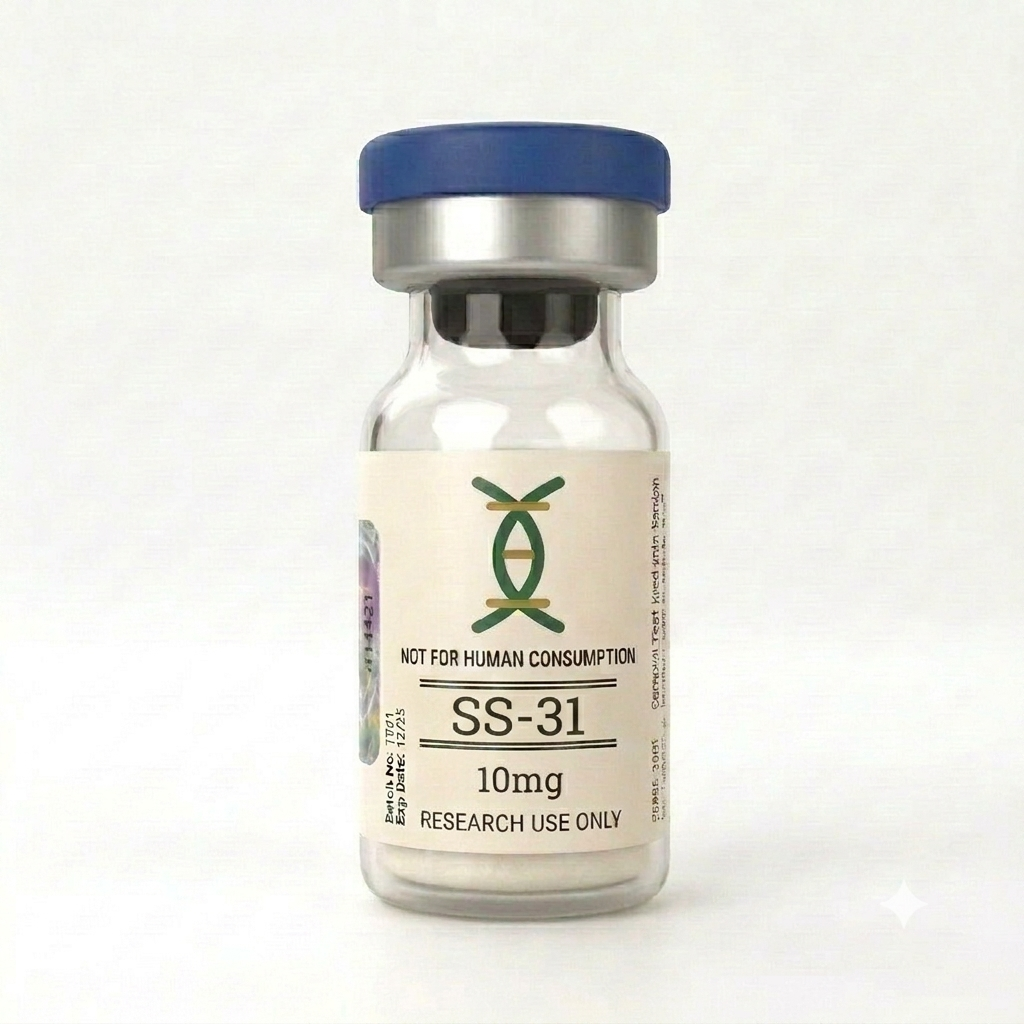
SS-31, also known as Elamipretide or MTP-131, is a mitochondria-targeting tetrapeptide studied for its association with the inner mitochondrial membrane and the phospholipid cardiolipin.
It is widely referenced in mitochondrial-function and cellular-bioenergetics research, and is among the more frequently studied mitochondria-targeted research peptides.
Specs: Identity: SS-31 (Elamipretide / MTP-131) · Fill: 10 mg · Form: Lyophilized powder · Purity: ≥98% (HPLC) · Storage: -20°C, protect from light
For research use only. Not for human or veterinary use. Not a drug, food, or dietary supplement. Not for diagnostic or therapeutic use.
Preclinical Research & Case Studies
Mechanism: A mitochondria-targeting tetrapeptide that selectively accumulates in the inner mitochondrial membrane, binding the phospholipid cardiolipin. This is proposed to stabilize cristae structure, reduce reactive-oxygen-species production, and support ATP output.
- Elamipretide review (2025), Int. J. Molecular Sciences (26:944): Summarizes preclinical protective and restorative effects across models of heart failure, neurodegeneration, ischemia–reperfusion injury, metabolic syndromes, and muscle atrophy, tied to cardiolipin stabilization and reduced oxidative stress.
Model: Review of cell and animal disease models | Source →
- Idiopathic pulmonary fibrosis study: In a bleomycin-induced mouse model, SS-31 significantly suppressed pulmonary fibrosis and inflammation — improving histology and reducing extracellular-matrix deposition — by inhibiting NLRP3-inflammasome activation in macrophages.
Model: Bleomycin-induced mouse model | Source →
- Siegel et al. (2013), Aging Cell: In aged mice, SS-31 reversed age-related declines in skeletal-muscle mitochondrial function — restoring ATP production, oxidative-phosphorylation coupling, and cellular energy state — and improved fatigue resistance, with no observable effect in young mice.
Model: Aged vs. young mouse skeletal muscle | Source →
- Campbell et al. (2019): In 26-month-old mice treated for 8 weeks (3 mg/kg/day), SS-31 reversed the age-related decline in maximum mitochondrial ATP production, improved OXPHOS coupling, restored redox homeostasis, and increased exercise tolerance — without increasing mitochondrial content.
Model: Aged C57BL/6 mice (8-week treatment) | Source →
- Szeto et al. (2011), renal ischemia-reperfusion research: SS-31 reduced oxidative damage and preserved renal function in ischemia-reperfusion models, protecting mitochondria during the reperfusion window when reactive-oxygen-species generation peaks.
Model: Animal renal ischemia-reperfusion models | Source →
- Glomerular-aging study (2017), Kidney International: A short course of SS-31 in advanced-age mice improved glomerular architecture — reducing podocyte-injury markers, improving cytoskeletal integrity, and raising glomerular endothelial-cell density.
Model: Advanced-age mouse kidney | Source →
Research stage: Extensive multi-species preclinical base; SS-31/Elamipretide has also advanced into sponsored human clinical programs outside the research-use context.