✦ Free shipping on U.S. orders over $150  ·  Use code WELCOME10 for 10% off your first order  ·  Powder only, research grade ✦
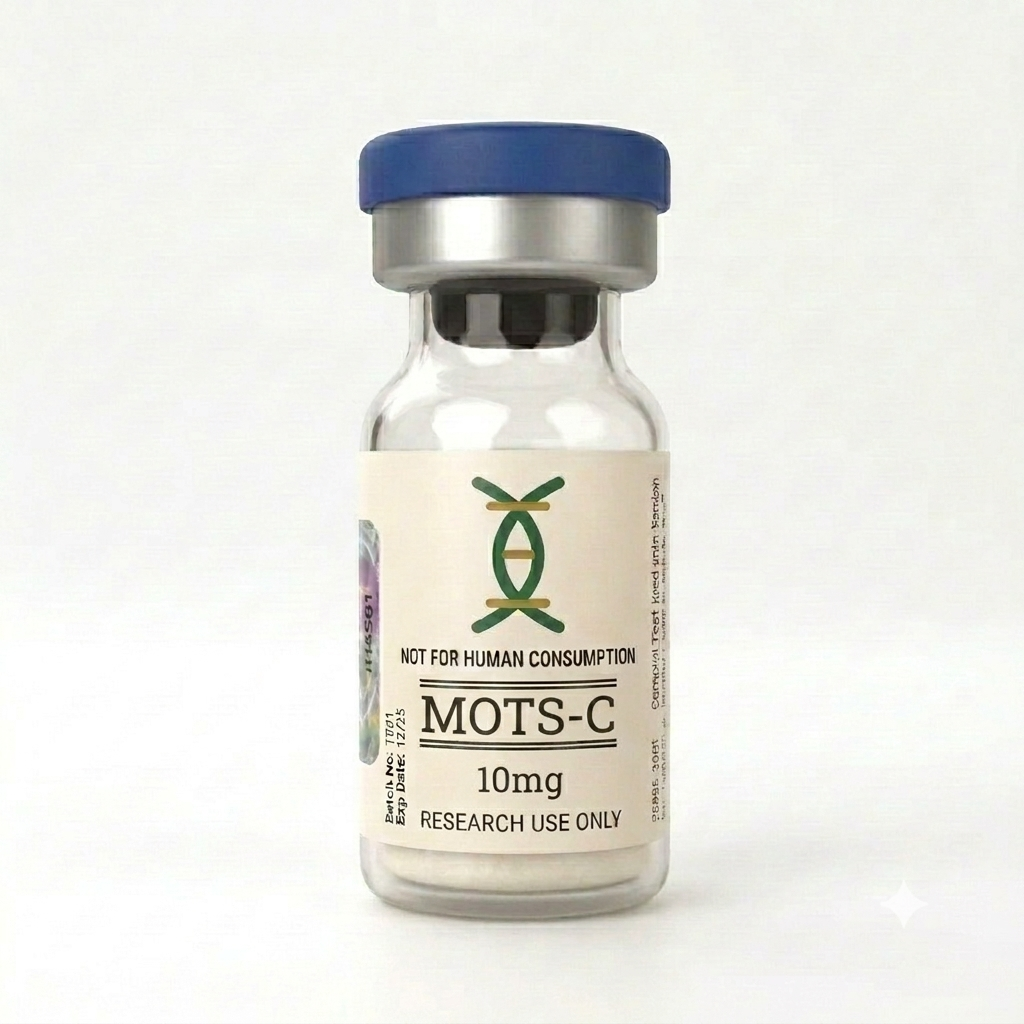
MOTS-c — 10 mg

Precursor:

MOTS-c — 10 mg

A mitochondrial-derived peptide studied in metabolic-regulation and cellular-stress-response research.

$140.00

Description

MOTS-c is a mitochondrial-derived peptide encoded within the mitochondrial genome, part of an emerging class of peptides that has attracted significant research interest.

It has been studied in metabolic-regulation, mitochondrial-biology, and cellular-stress-response research models, and is a frequent subject in the field of mitochondrial-derived-peptide research.

Specs:  Identity: MOTS-c · Fill: 10 mg · Form: Lyophilized powder · Purity: ≥98% (HPLC) · Storage: -20°C, protect from light

For research use only. Not for human or veterinary use. Not a drug, food, or dietary supplement. Not for diagnostic or therapeutic use.

Preclinical Research & Case Studies

Mechanism: A 16-amino-acid peptide encoded within the mitochondrial 12S rRNA gene. Proposed to act largely on skeletal muscle, inhibiting the folate one-carbon cycle to activate AMPK, with downstream effects on glucose uptake and lipid handling.

  • Lee, Zeng, Drew et al. (2015), Cell Metabolism (21:443–454): The foundational MOTS-c paper: intraperitoneal MOTS-c improved insulin sensitivity in diet-induced obese mice, reduced age-related insulin resistance in older mice, and increased skeletal-muscle glucose uptake, with AMPK activation identified as the mechanism.
    Model: Diet-induced obese and aged mice + myocytes | Source →
  • Kim et al. (2019), Physiological Reports: An unbiased metabolomics approach found MOTS-c reduced sphingolipid, monoacylglycerol, and dicarboxylate pathways (elevated in obesity/T2D models) and increased beta-oxidation, improving insulin sensitivity in diet-induced obese mice.
    Model: Diet-induced obese mice (metabolomics) | Source →
  • Reynolds et al. (2021), Nature Communications (12:470): MOTS-c significantly enhanced physical performance in young (2-mo), middle-aged (12-mo), and old (22-mo) mice; late-life (23.5-mo) intermittent treatment increased physical capacity and healthspan, alongside regulation of nuclear metabolism/proteostasis genes.
    Model: Young, middle-aged, and aged mice | Source →
  • Muscle-atrophy signaling study (2021): Found MOTS-c reduced myostatin and muscle-atrophy signaling in skeletal muscle, complementing reports that MOTS-c improves muscle strength and exercise capacity in high-fat-diet-fed and aged mice.
    Model: High-fat-diet-fed and aged mice | Source →
  • Pancreatic-islet senescence study (2025), Experimental & Molecular Medicine: MOTS-c levels fell with aging in islet cells; treating aged mouse islets with MOTS-c reduced β-cell senescence and improved glucose intolerance in diabetic-mouse models.
    Model: Aged and diabetic mouse islet models | Source →

Research stage: Mechanism replicated across rodent and cell-line studies; circulating MOTS-c declines with age in humans, but no administered-MOTS-c human study has read out.

Related Products

A foundational metabolic coenzyme and research reagent used across cellular-energy and aging-research studies.

A mitochondria-targeting tetrapeptide studied for its association with cardiolipin and the inner mitochondrial membrane.