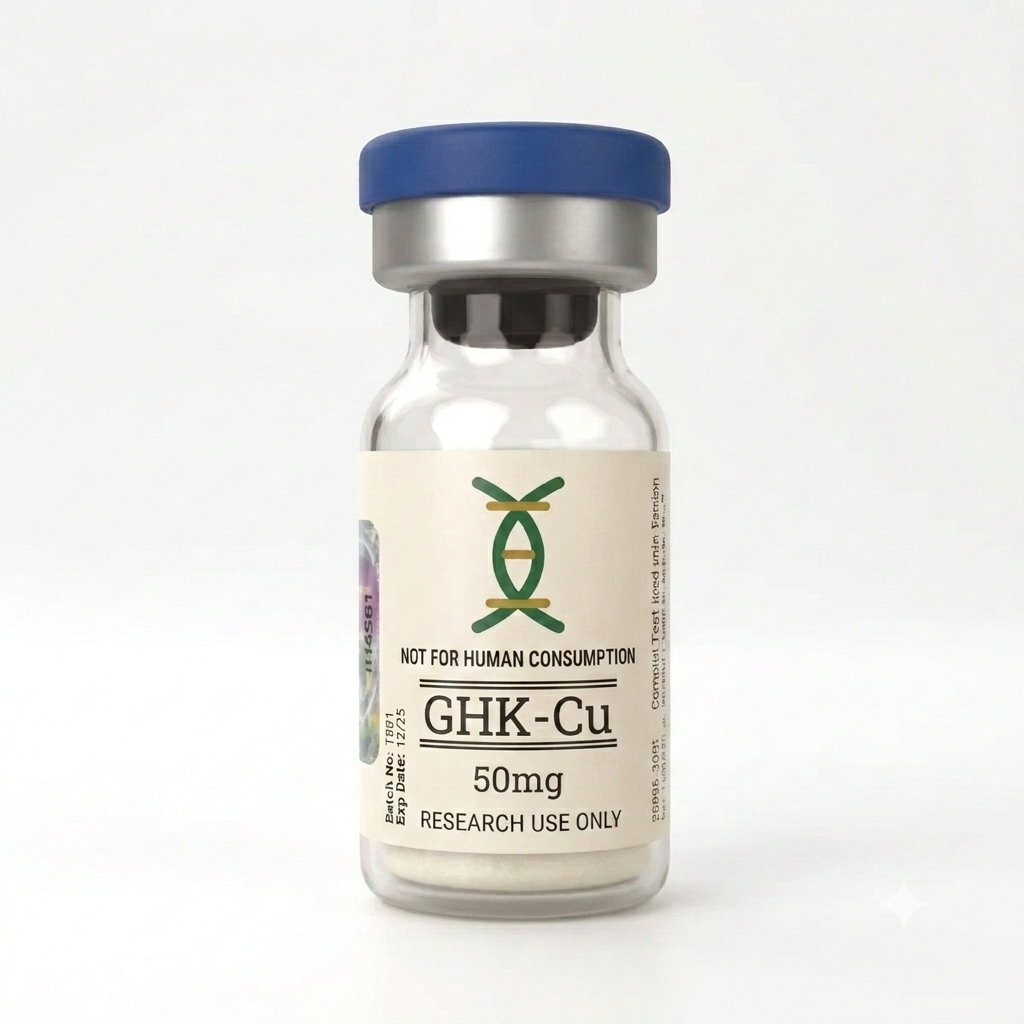
GHK-Cu is a naturally occurring copper-binding tripeptide, consisting of glycyl-L-histidyl-L-lysine complexed with copper. It occurs endogenously in human plasma and declines with age, which has made it a frequent subject of research interest.
GHK-Cu has been extensively investigated in skin-remodeling, extracellular-matrix, and gene-expression research models, and is commonly referenced in cosmetic-science and regenerative-research literature.
Specs: Identity: GHK-Cu (copper tripeptide) · Fill: 50 mg · Form: Lyophilized powder · Purity: ≥98% (HPLC) · Storage: -20°C, protect from light
For research use only. Not for human or veterinary use. Not a drug, food, or dietary supplement. Not for diagnostic or therapeutic use.
Preclinical Research & Case Studies
Mechanism: A naturally occurring copper-binding tripeptide that declines with age. Studied extensively for collagen/elastin synthesis, extracellular-matrix remodeling, and broad gene-expression modulation.
- Maquart, Pickart, Laurent et al. (1988), FEBS Letters (238:343–346): GHK-Cu stimulated collagen synthesis in cultured fibroblasts at concentrations as low as 10⁻¹² M, peaking near 10⁻⁹ M, independent of changes in cell number.
Model: Cultured fibroblasts (in vitro) | Source →
- Maquart et al. (1993), Journal of Clinical Investigation: In a rat wound-chamber model, GHK-Cu produced concentration-dependent increases in type-I and type-III collagen mRNA (about twice the stimulation of non-collagen proteins) without corresponding TGF-beta mRNA increases.
Model: Rat wound-chamber model | Source →
- Gene-expression analysis (2014), Gene: Profiling of human fibroblast cultures found GHK significantly modulated expression of roughly 4,699 genes — up-regulating tissue-repair and remodeling genes while down-regulating genes tied to inflammation and fibrosis.
Model: Human fibroblast cultures (in vitro) | Source →
- Pickart & Margolina (2018), Int. J. Molecular Sciences (19:1987): A review synthesizing the gene-level data, including Broad Institute Connectivity-Map findings that GHK-Cu influences DNA-repair and tissue-remodeling gene programs.
Model: Review of preclinical / gene-expression data | Source →
- COPD gene-signature study (2015): A multi-institution study found GHK reversed the gene-expression signature of emphysema/COPD across 127 disease-associated genes; in vitro, GHK restored the ability of COPD-patient lung fibroblasts to contract and remodel collagen gel to near-normal levels.
Model: Human lung fibroblasts + gene-expression analysis | Source →
Research stage: Deep preclinical and mechanistic base; limited controlled human data exists in dermatology (topical), outside the research-use context.